Four ICT entry models you can trade forever — HTF POI + Shift + FVG, the IDM variant, the OTE variant (0.62-0.79) and the Box Setup. Full checklist for every model with premium TradingEdges visuals.
Most traders die from "trading everything that moves". Pro funded traders do the opposite — they keep 3-4 fixed models and trade only those, forever.
These are 4 setups built on three pillars: Liquidity → Structure → Edge. Every model starts the same way (an HTF liquidity grab at a Point of Interest) but differs in its confirmation and entry.
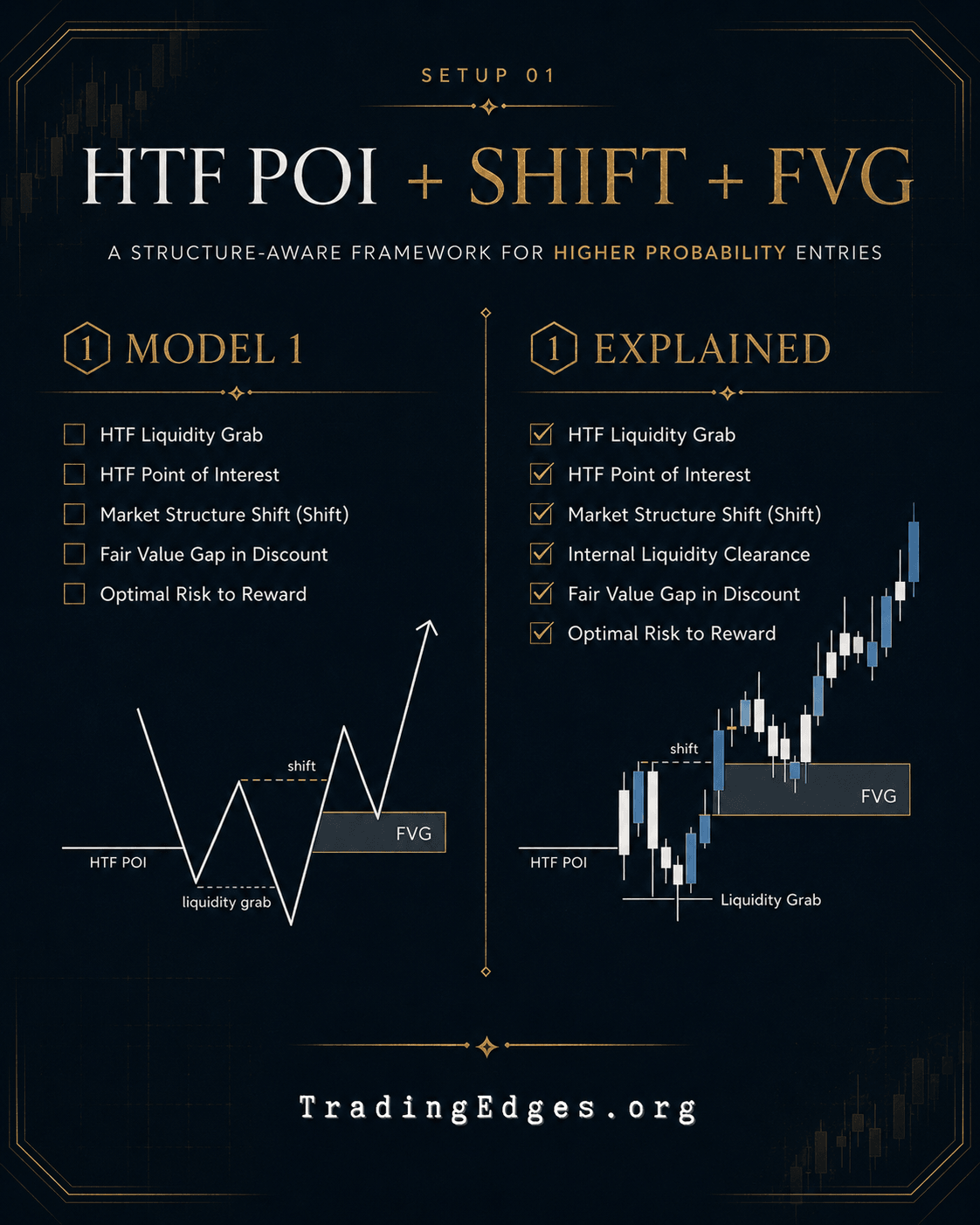
Setup 01 — HTF POI + Shift + FVG (the mother model)
The 5-point checklist: 1. HTF Liquidity Grab — price sweeps liquidity on the higher timeframe 2. HTF Point of Interest — the sweep happens at a key zone (OB / FVG / ERL) 3. Market Structure Shift — the lower timeframe changes structure 4. FVG in Discount — the displacement leaves an FVG on the discount side 5. Optimal Risk to Reward — tight stop, distant target
Enter on the FVG retest after the shift. This skeleton carries every other model.
Setup 02 — adding IDM (Inducement)
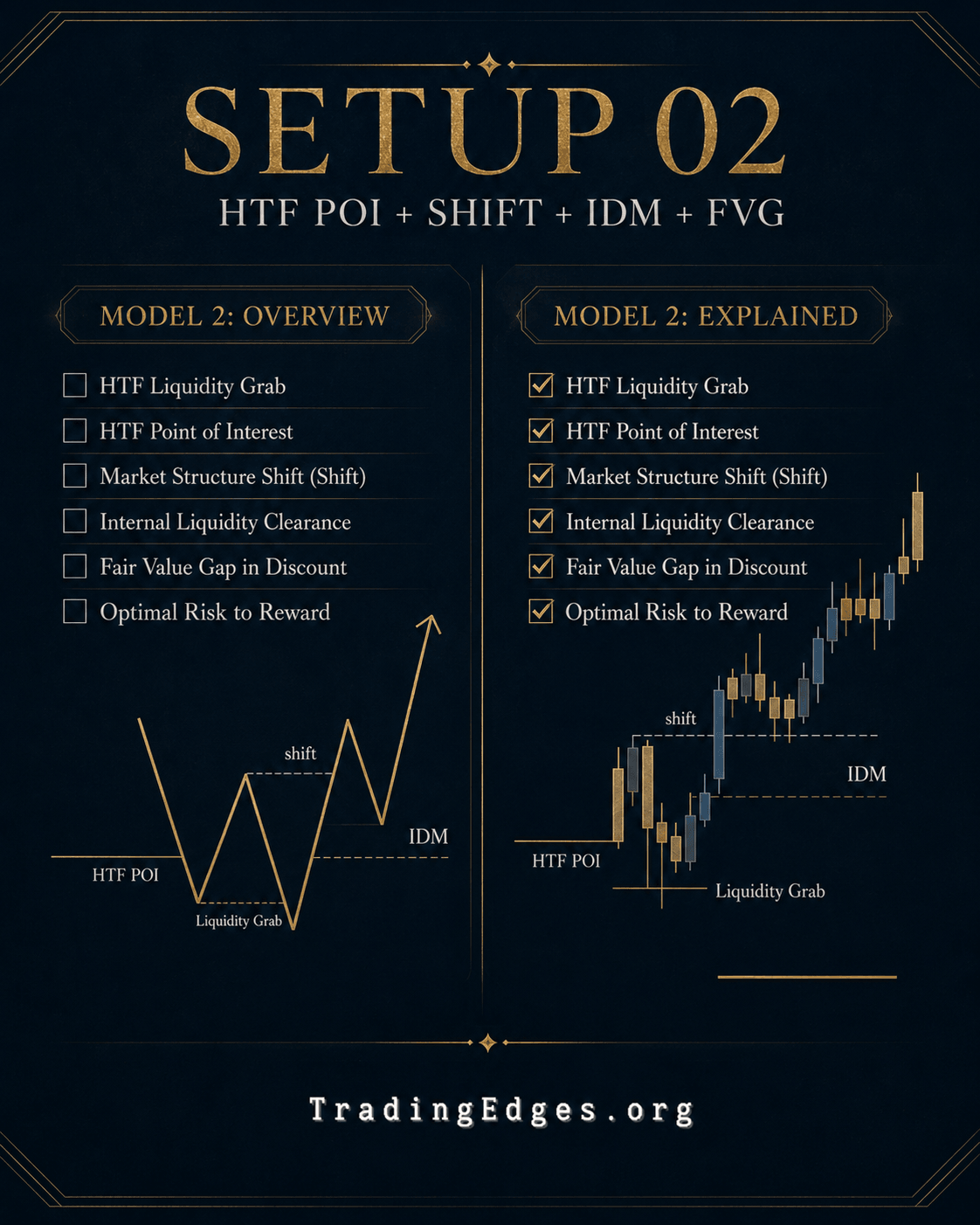
Model 2 adds Internal Liquidity Clearance (IDM) — before entering, you must see price "collect the inducement" (the small liquidity pocket that baits early buyers/sellers).
Why it matters: if the IDM has not been taken, price usually comes back for it later — your stop gets swept right before the real move. Rule: no IDM clearance, no entry.
Setup 03 — adding OTE (Optimal Trade Entry 0.62-0.79)
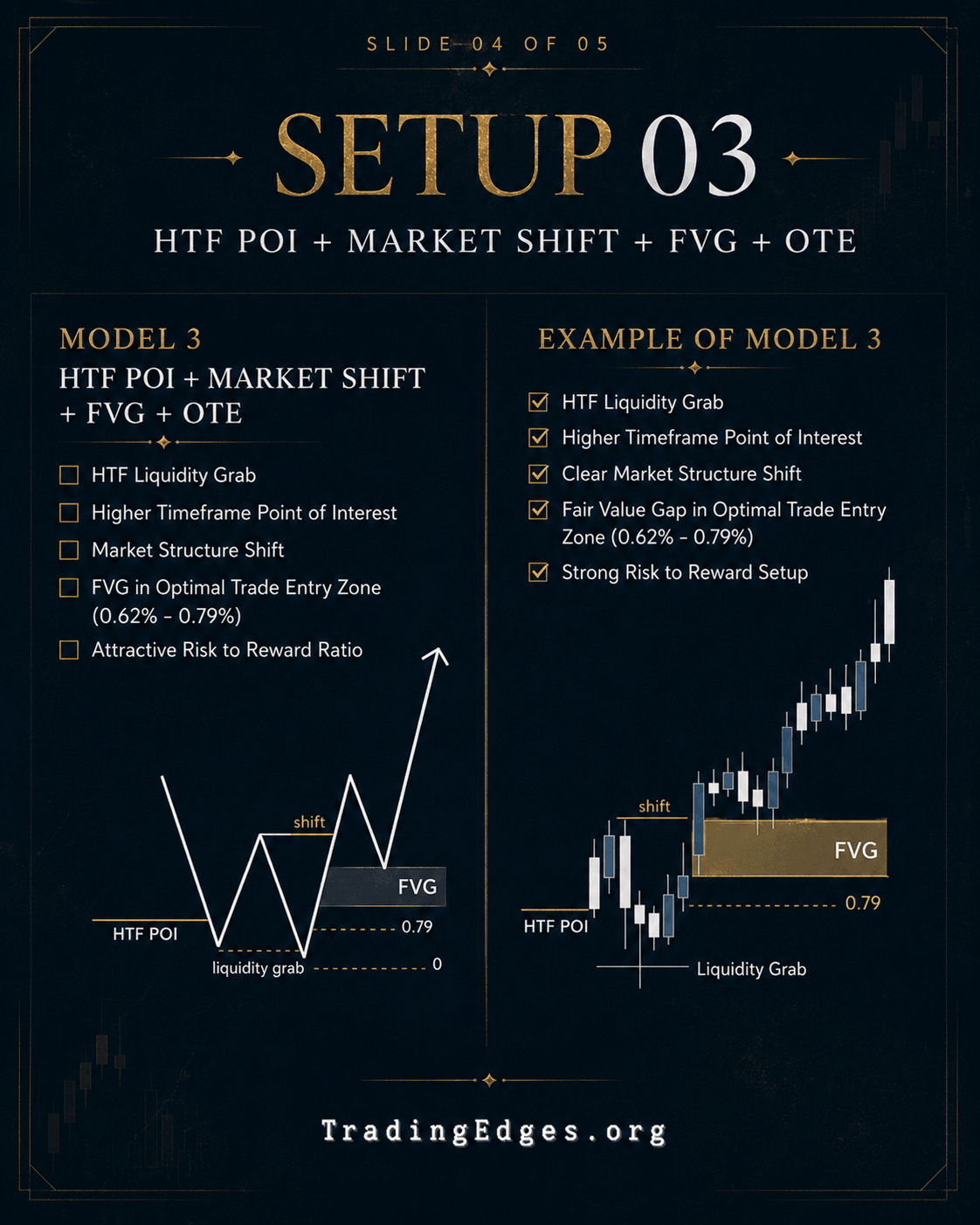
Model 3 filters entries through the OTE zone — the fibonacci retracement band between 0.62 and 0.79 of the displacement leg.
Full conditions: HTF grab + POI + Shift + an FVG inside the OTE zone. An FVG that deep gives the shortest stop relative to target — the most attractive R:R of all four models.
Setup 04 — the Box Setup (simplest, most frequent)
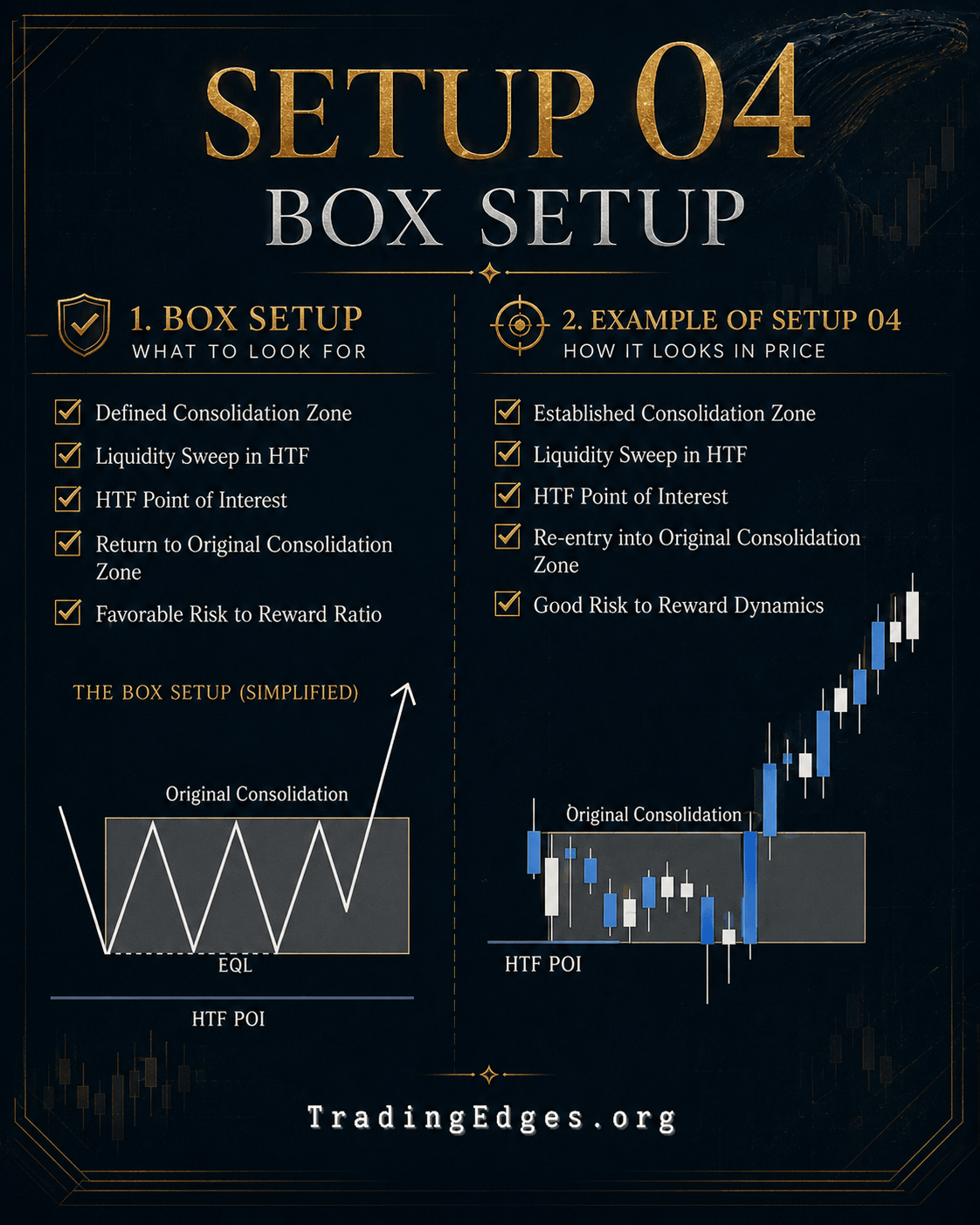
The Box Setup trades around an "original consolidation": 1. Frame the Original Consolidation (a clear accumulation box) 2. Wait for an HTF liquidity sweep outside the box (collecting EQL/EQH) 3. Price returns to an HTF POI inside the box 4. Re-entry into the box = the signal 5. Target = the opposite side of the box, with R:R worth taking
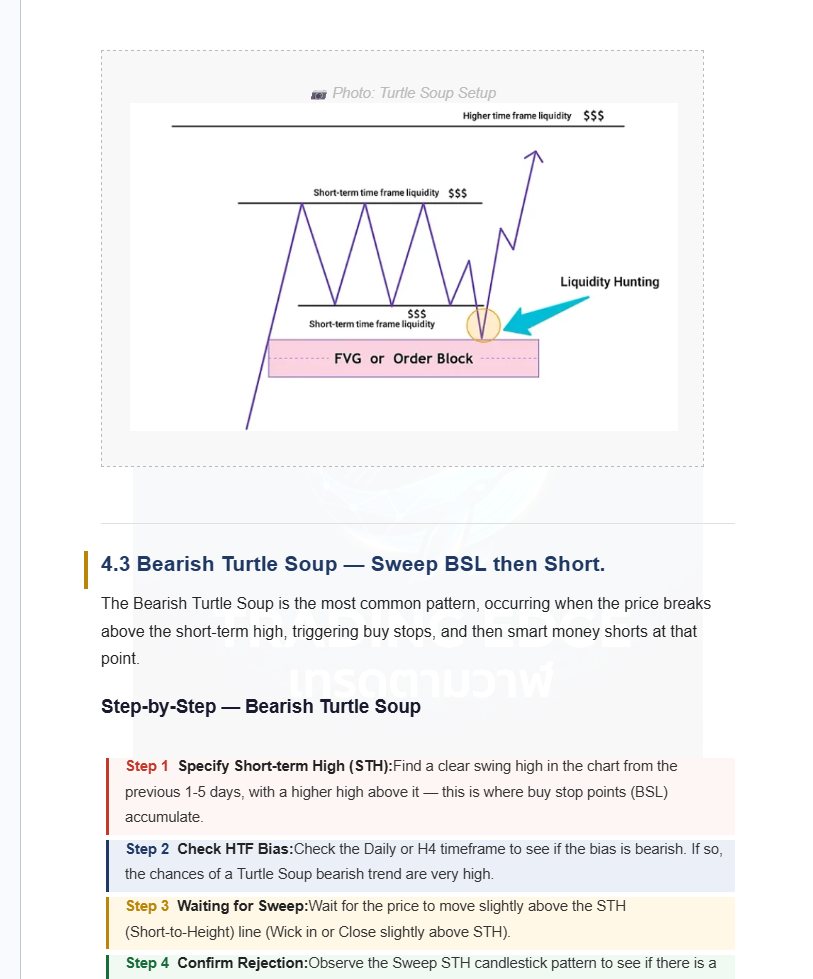
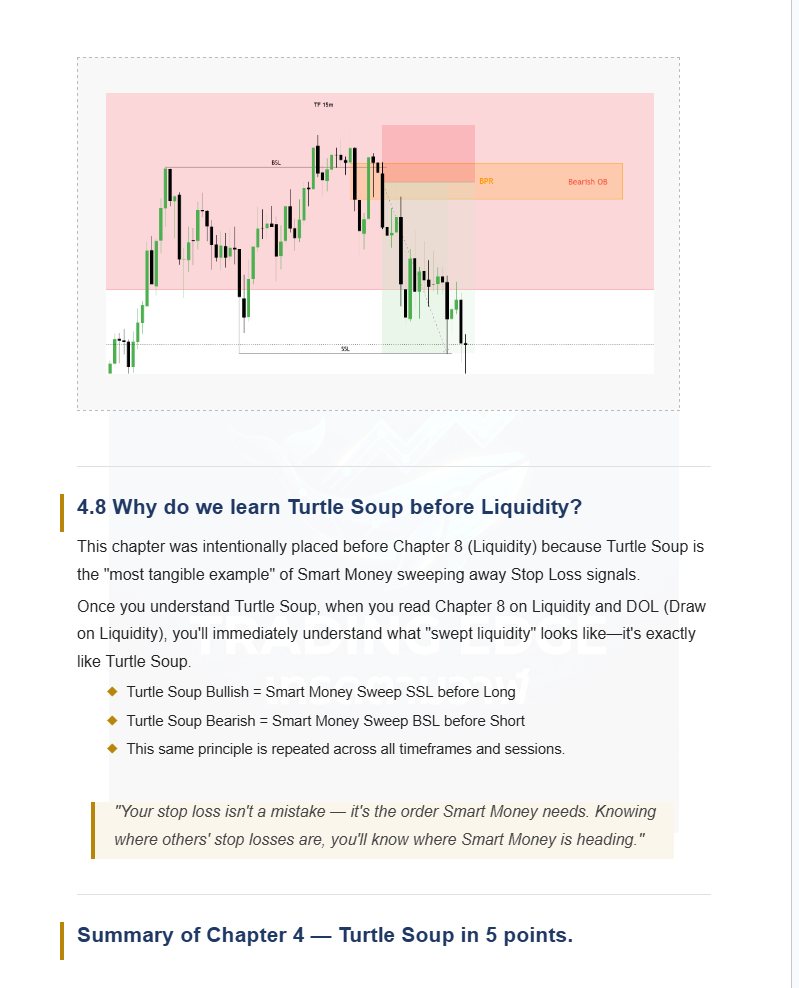
Read alongside Turtle Soup — same sweep logic on a different clock — and always pick your side first with Daily Bias.
Inner Circle Trader Bible — 500 pages · every setup + live trade examples + printable checklists
คำถามที่พบบ่อย
Which setup should I start with?+
Setup 01 (the mother model) always — the other three are Setup 01 plus extra filters. Once you trade Setup 01 consistently, add the IDM filter (Setup 02), then move to OTE (Setup 03). The Box Setup (04) can be studied separately since its range-based logic differs from the first three.
How is the OTE 0.62-0.79 measured?+
Drag a fibonacci from the start of the displacement (the swing low for buys) to its end (the swing high). The 0.62-0.79 retracement band is the OTE — deep enough for a tight stop, not so deep the structure breaks. ICT treats 0.705 as the sweet spot.
How do I spot IDM (inducement) on a chart?+
Look for the small swing sitting between current price and your POI — usually a minor low/high where early traders parked their stops. If price has not taken that pocket yet, wait. Price collecting the IDM and then reaching your POI = a complete, much higher-probability setup.
- Michael J. Huddleston (ICT) — Market Maker Models & OTE mentorship
- TradingEdges ICT Concept Playbook — 500 pages