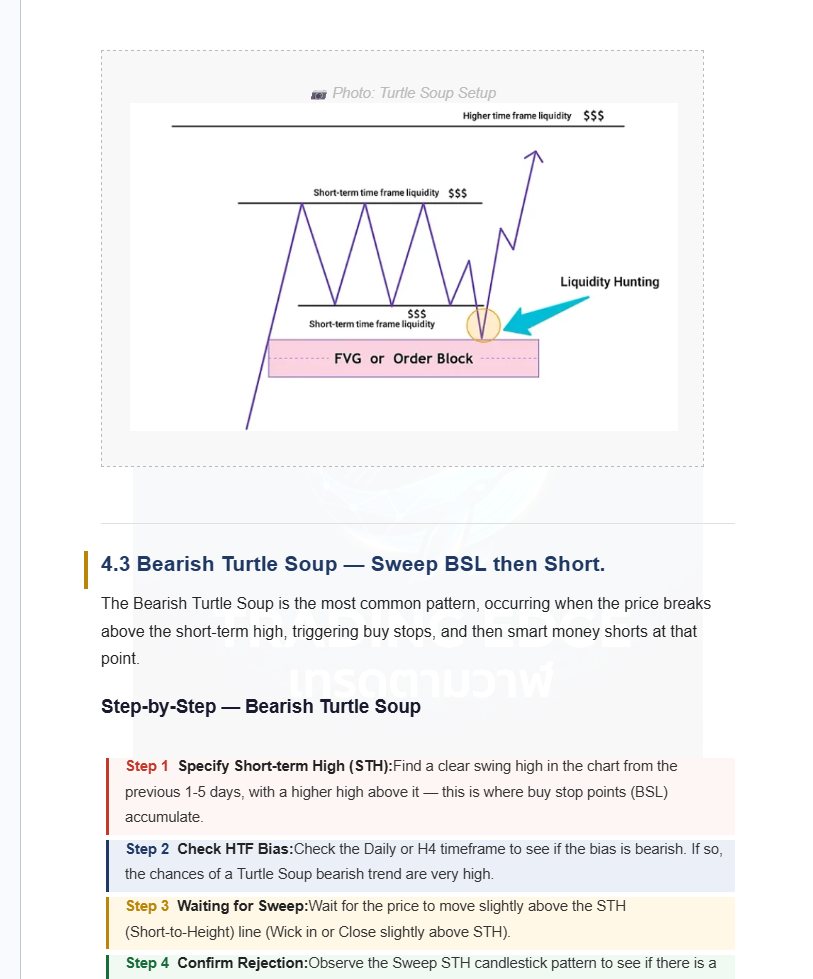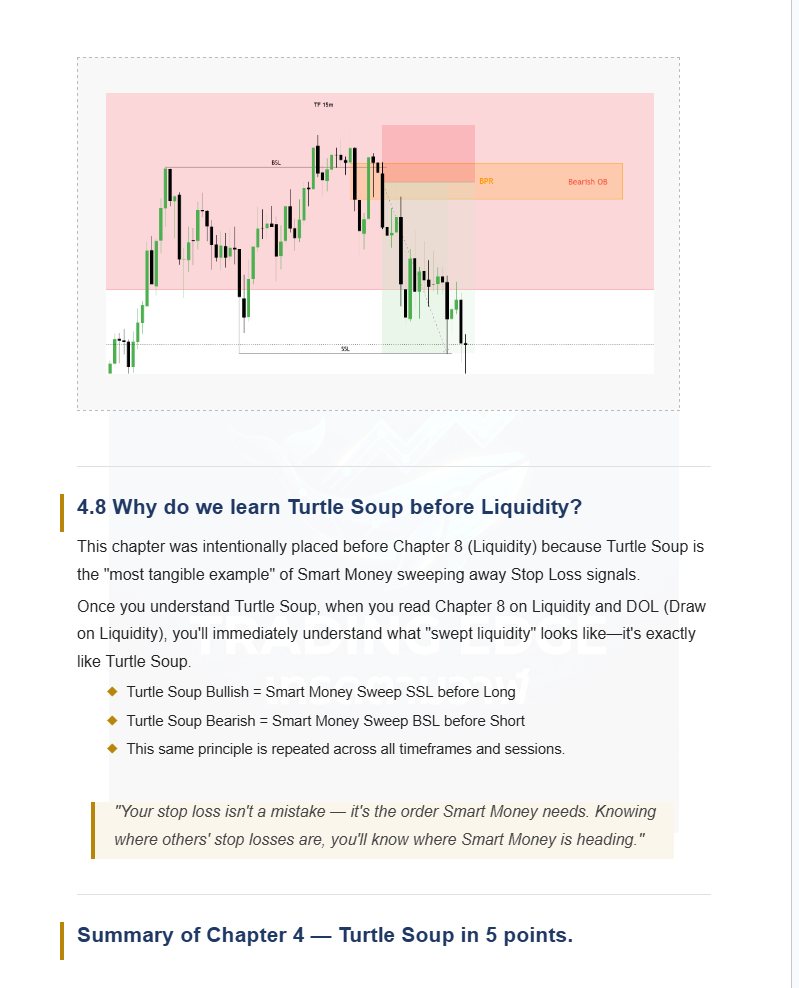
Internal Range Liquidity (IRL), External Range Liquidity (ERL), Dealing Range, and the "Price has Two Objectives" principle — the structural backbone of ICT that makes Price Action stop feeling random. Every chart from the TradingEdges premium slide series. For funded traders who want to read Smart Money with real structure.
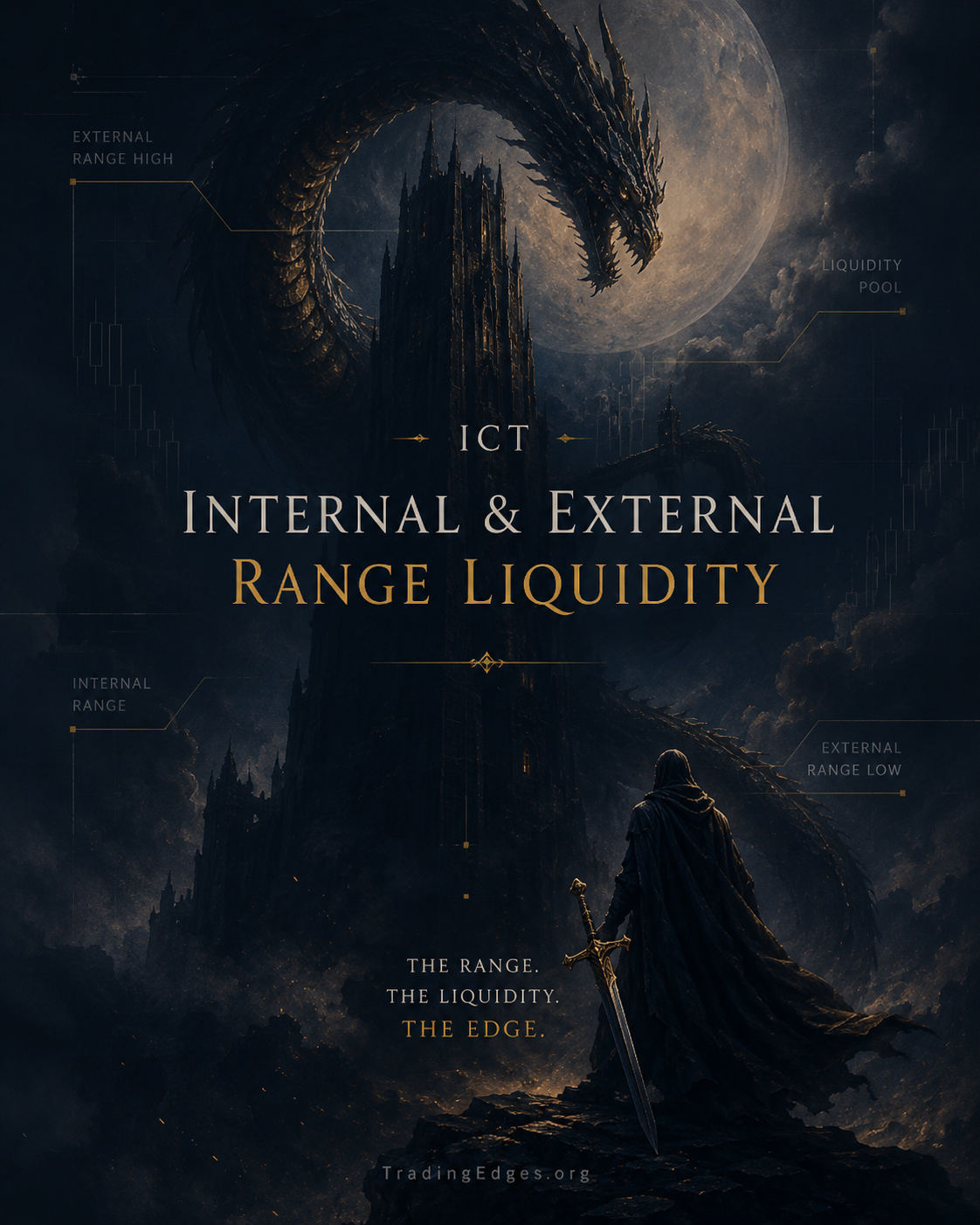
Price feels "random" — because you still don't see the two-layer structure the algorithm walks through every single time. Internal Range Liquidity (IRL) and External Range Liquidity (ERL) are the twin concepts ICT uses to explain why price "detours" before reaching the real destination. Once you understand both, Price Action stops being noise and becomes an ordered list of objectives.
This article distills the entire Inner Circle Trader premium slide series into one continuous narrative. For deep-dive diagrams and trade setups for each concept, visit the ICT Concept Library.
1. Internal Range Liquidity (IRL) — Everything inside the Dealing Range
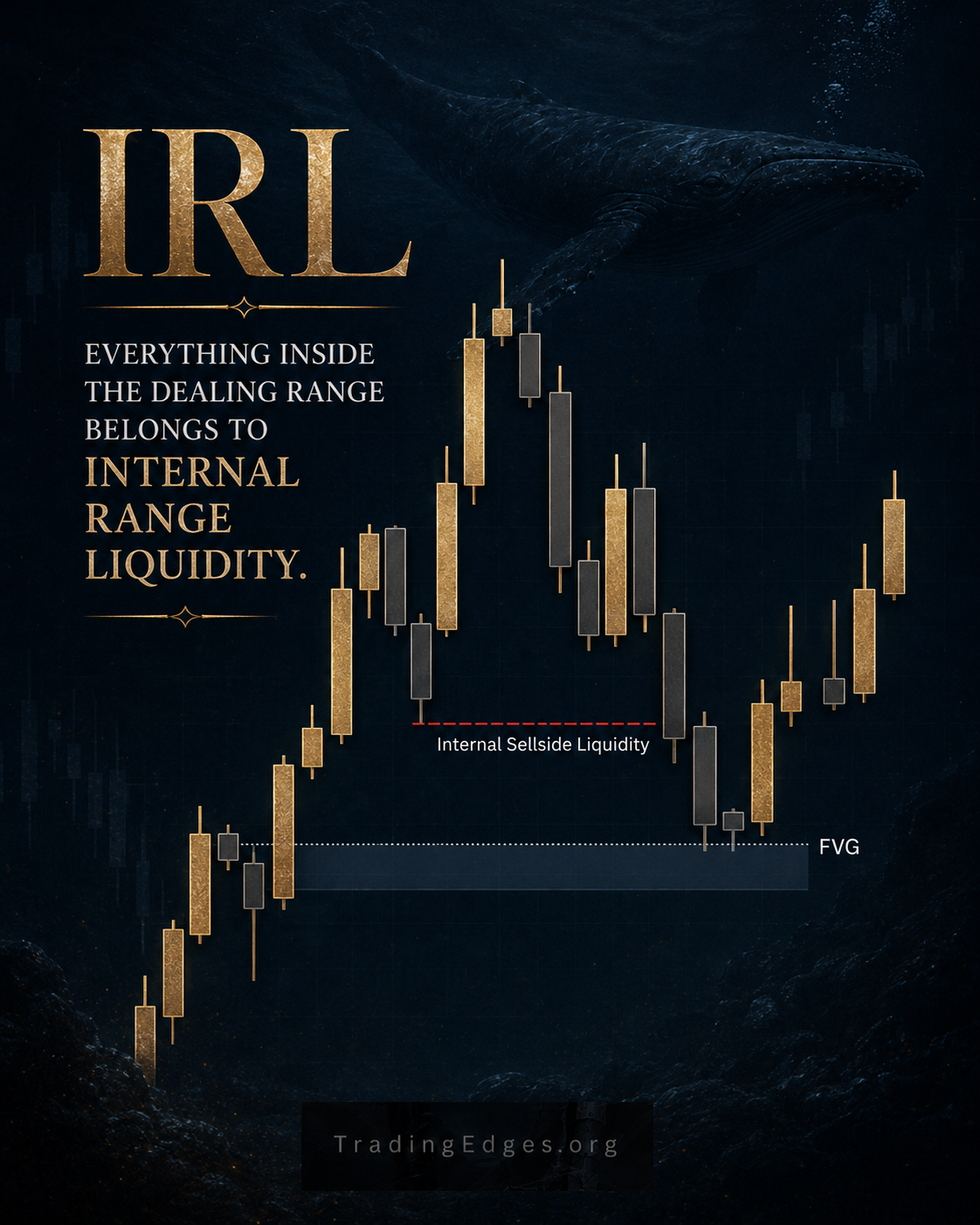
IRL is every swing high / swing low inside the range, every FVG that hasn't rebalanced, and every stop pool at minor highs / lows — all sitting between the upper and lower boundary of the higher-timeframe dealing range. The algorithm reads these as a short-term objective queue before it walks price out to interact with ERL.
That's why price never travels in a straight line — it has to detour through internal sellside, fill an FVG, collect liquidity at a minor low, and only then push toward the real target outside.
Deep rule: a bullish dealing range typically sweeps Internal Sellside first before targeting External Buyside. A bearish range mirrors this perfectly. The rhythm is always "internal sweep → external delivery".
2. External Range Liquidity (ERL) — Smart Money's real destination
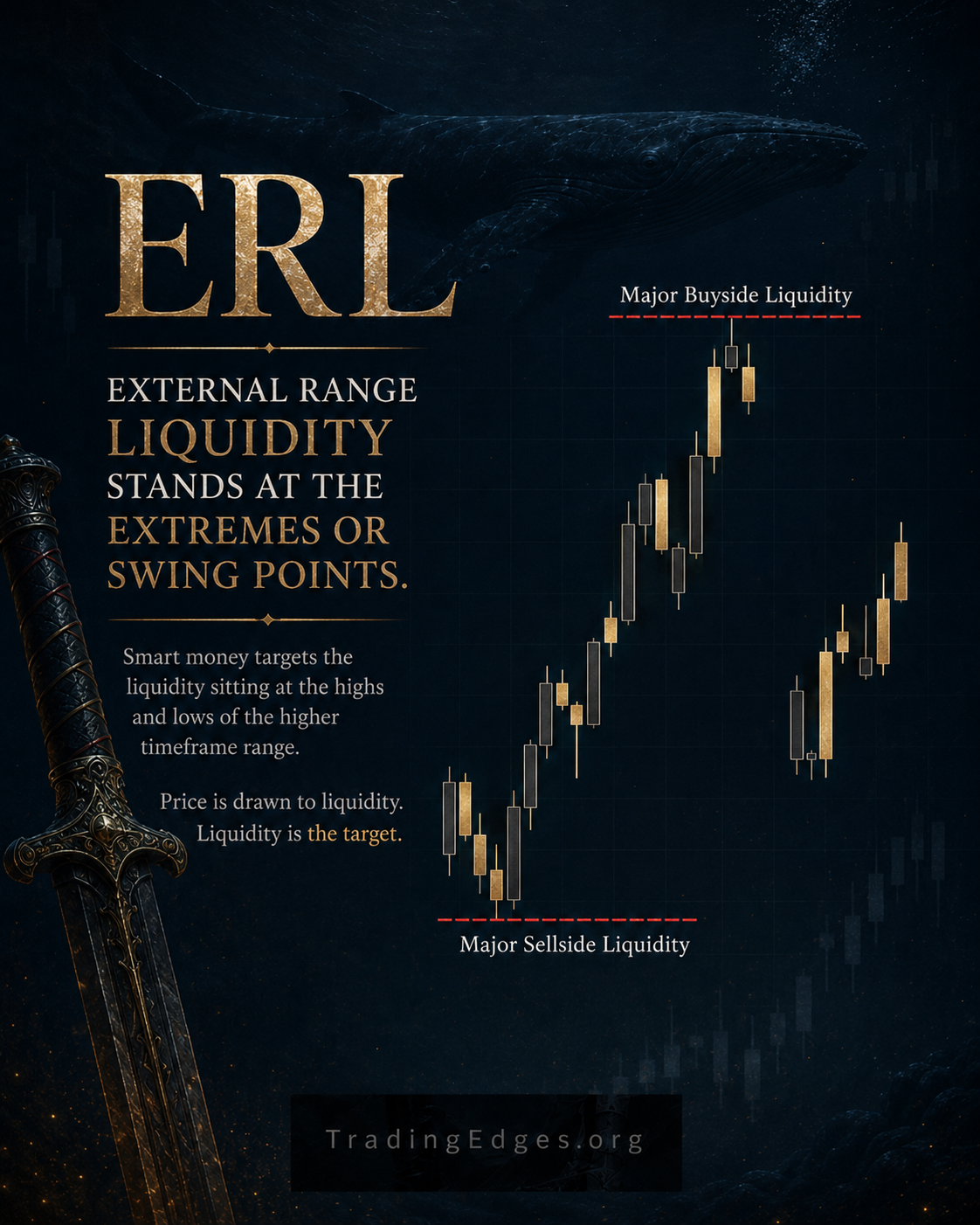
ERL is the stop pool at the swing extremes of a higher-timeframe range — Major Buyside Liquidity above the peak, Major Sellside Liquidity below the trough. Not internal scratch, but the level where retail traders, prop firms, and small institutions park their stops.
Mental model: IRL = snacks on the road to dinner. ERL = the actual dinner.
The #1 mistake of new traders: fading ERL before the sweep. They see price near resistance and short — but price hasn't swept buyside yet, which is exactly where the algorithm "wants to go". Result: stopped out by the move you got right.
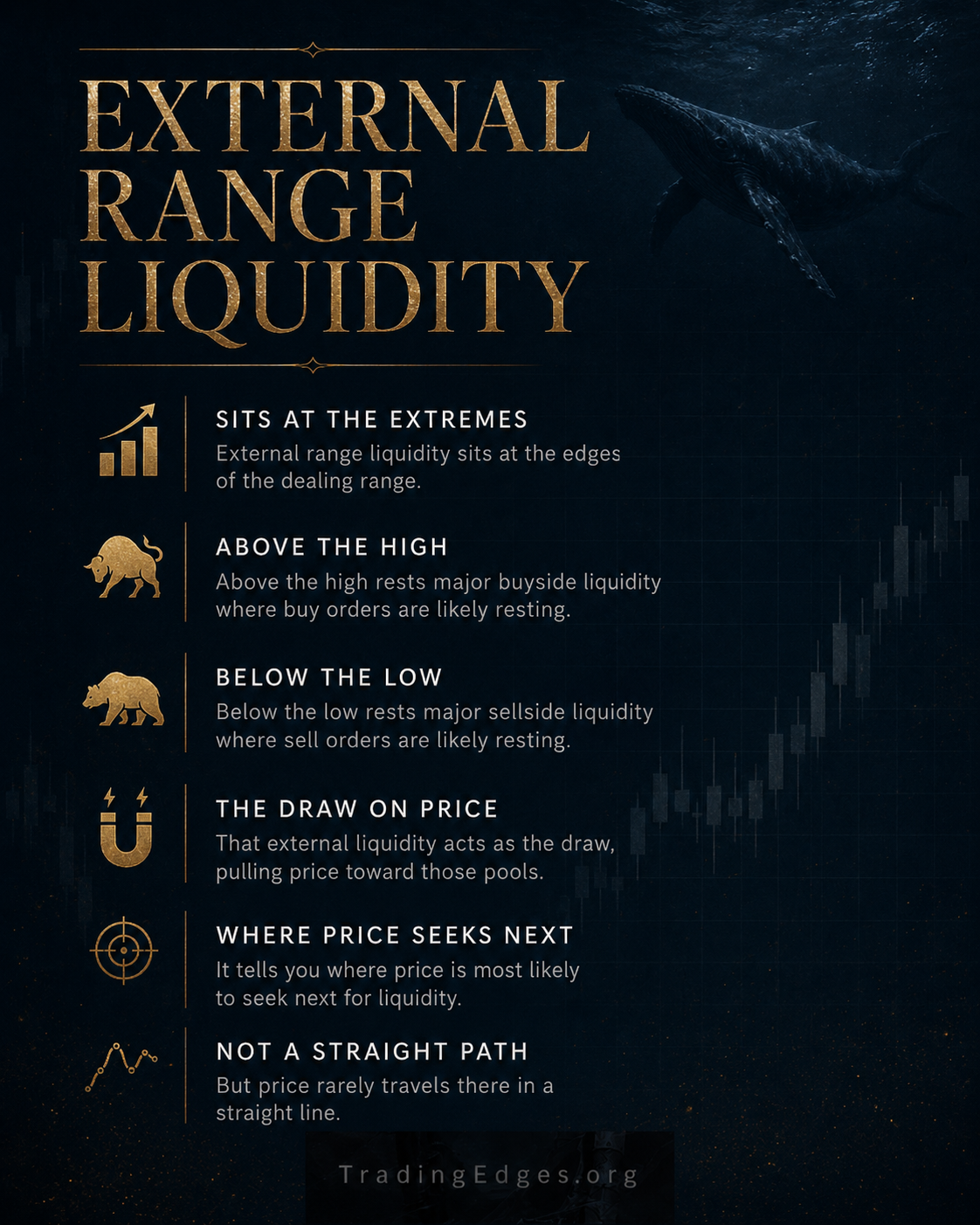
The 6 core ERL principles — compact, immediately actionable:
3. Dealing Range — Inside the Range is where everything happens
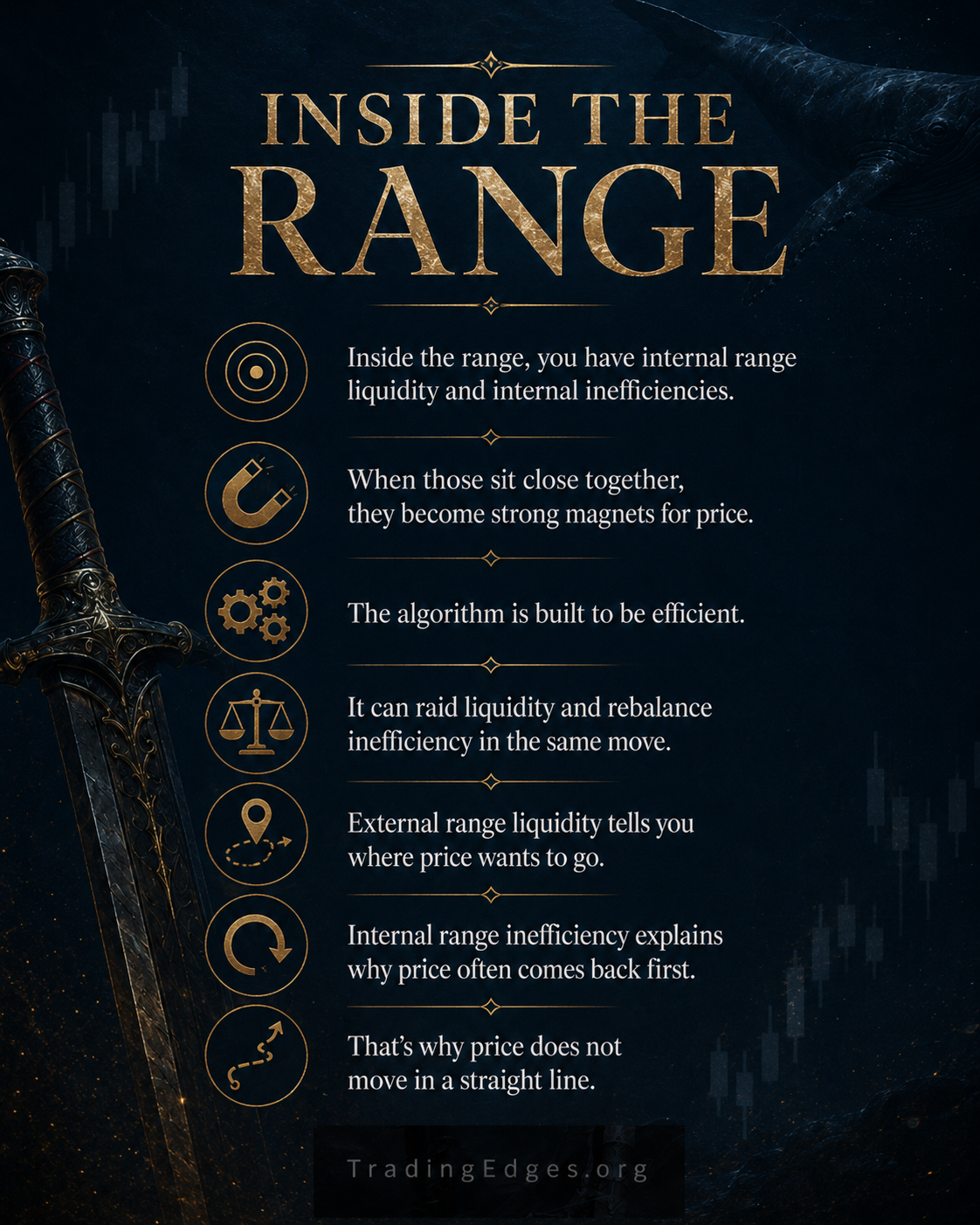
A Dealing Range is higher-timeframe consolidation between a swing high and a swing low that price is currently trading inside. Those two boundaries define your ERL targets. Everything inside is IRL.
Mark the range correctly, and Price Action transforms from chaos into a clearly ordered set of objectives. Every entry, every target, every stop loss you place will reference these two boundaries.
Key rule: the algorithm is built to be efficient — it can raid liquidity and rebalance inefficiency in the same move. That's why price often comes back to fill internal FVG right after sweeping a minor low (one sweep, two objectives served).

ICT Concept Playbook · every concept · every model · every entry pattern in one indexed document · 500+ pages · written by the TradingEdge team — Asia's Top Funded Trader Topstep $750K
4. Price Has Two Objectives — Seek Liquidity & Rebalance Inefficiency
This is the single most important mental model in ICT. Price moves for two reasons only:
(1) Seek Liquidity — pools of resting orders (stops above swing highs, stops below swing lows, pending orders). They are binary in nature — either there or not. Once swept, the pool is gone and the algorithm moves to the next.
(2) Rebalance Inefficiency — Fair Value Gaps (FVG) are voids the algorithm leaves behind during strong displacement. They are geometric — a "zone to fill", not a point holding stops.
Where most traders get confused: they target FVGs instead of liquidity, or they trade a swing high as if it were a zone to rebalance when it's actually a stop pool. Internalising this distinction is an immediate upgrade to how you read price.

5. From IRL to ERL — the delivery rhythm price walks every time
This chart shows exactly why price feels random until you understand the move from IRL to ERL.
Standard path: price sits inside the range → sweeps Internal Sellside first (internal raid) → fills an old FVG → breaks swing structure → runs to External Range Liquidity outside the range.
If you only watch the moment price "explodes", you'll think it walks randomly. But map IRL and ERL ahead of time and you'll "see" the path before it forms. That's the edge professional traders have.
How to apply: open a HTF chart (Daily / 4H) → mark the dealing range → list internal IRL + external ERL → drop down to LTF (15m / 5m) → wait for confluence, then take the trade. Don't predict — let structure narrate.

Summary — the 4-layer structure for reading Price Action every time
Layer 1 — Mark the Dealing Range (swing high ↔ swing low on Daily / 4H) → you have the frame.
Layer 2 — List every IRL inside the range (internal swings + FVG + inefficiencies) → you have the short-term objective queue.
Layer 3 — Define ERL at the swing extremes (Major Buyside + Sellside) → you have the real destination.
Layer 4 — Apply Two Objectives to every move: price is either seeking liquidity or rebalancing inefficiency. Nothing else.
Drill these four layers every time you open a chart, and Price Action will always have structure. No move is random. Every move has a reason.
For deep-dive on each concept:
• Internal Range Liquidity (IRL)
• External Range Liquidity (ERL)
ICT Concept Playbook — 500 pages · every concept · every model · every entry pattern · one-time payment, lifetime access · by the TradingEdge team — Asia's Top Funded Trader
คำถามที่พบบ่อย
How is IRL different from an Order Block?+
IRL is a **pool of resting stops** inside the range (above an internal swing high or below an internal swing low). An Order Block is the **entry zone** where smart money positioned before the displacement. IRL tells you where price is going next; the Order Block tells you where you enter.
Is ERL the same as Resistance / Support?+
Similar, but not the same. ERL is a level where **real stops actually sit** — that's why smart money has to go and sweep them. Classic Resistance/Support is just a line retail traders draw. ERL acts like a magnet, not a wall. Price almost always sweeps past ERL before reversing — fading ERL before the sweep is the fastest way to get stopped out.
Which timeframe should I use for the Dealing Range?+
Most pros use Daily or 4H. It depends on style: Swing → Weekly/Daily, Intraday → Daily/4H, Scalp → 1H/15m. The rule is that the range's swing high and swing low must be **unambiguous**. If you're arguing with yourself about which high is "the" high, you haven't found a real range yet.
Is an FVG actually a form of Liquidity?+
**No.** An FVG is an **inefficiency** — a 3-candle gap where price delivered so fast that wick 1 and wick 3 don't overlap. Price comes back to fill it because the algorithm is built to be efficient. There are no stops inside an FVG, so it isn't liquidity. Confusing the two is what makes traders miss the real target — Two Objectives separates them cleanly.
- Michael J. Huddleston (ICT) — original mentorship recordings (private)
- TradingEdges ICT Concept Playbook — 500 pages compiled
- TradingEdges ICT Concept Library — diagram-based reference